
443-875-7606Call Now
Timonium, MD

Aphasia Therapy Near Timonium, MD

Personalized Speech and Language Therapy for Adults With Aphasia

Aphasia can make everyday communication feel unfamiliar and frustrating.

A person may know exactly what they want to say but struggle to find the right word. Someone else may have difficulty understanding longer conversations, reading a text message, writing an email, or following what a family member is saying.

For many adults, these changes occur suddenly after a stroke or brain injury.

Spectrum Speech Therapy provides aphasia therapy for adults near Timonium, MD, with individualized treatment focused on helping people communicate more successfully in everyday life.

Our office is located at Greenspring Station in Lutherville, convenient to Timonium, Towson, Cockeysville, Hunt Valley, Pikesville, and other Baltimore County communities.

Our licensed speech-language pathologists work with adults who experience aphasia following stroke, brain injury, or other neurological conditions. Treatment may address speaking, understanding language, reading, writing, conversation, word retrieval, and the use of communication strategies.

Every person's aphasia is different.

One client may primarily struggle to retrieve names and words. Another may speak fluently but have difficulty understanding what others are saying. Someone else may have significant difficulty communicating basic needs.

Treatment is personalized around the individual's abilities, priorities, and daily communication needs.

Learn more about Spectrum's comprehensive Adult Speech Therapy services, or contact Spectrum Speech Therapy to request an evaluation.

Schedule an Aphasia Therapy Evaluation443-875-7606

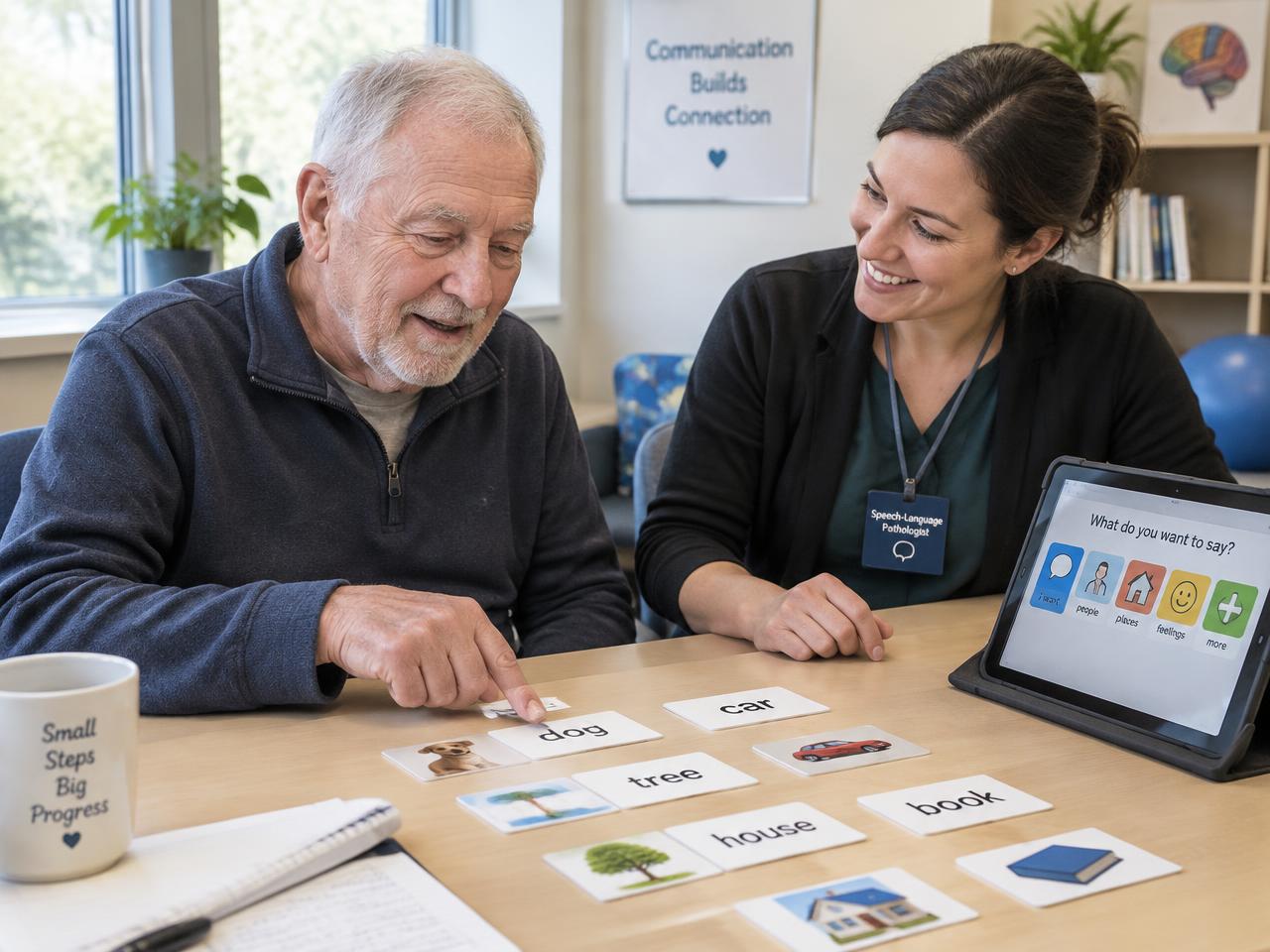
Adult participating in aphasia therapy near Timonium, Maryland

What Is Aphasia?

Aphasia is a language disorder caused by damage to areas of the brain involved in communication.

It can affect a person's ability to:

  • Speak
  • Find words
  • Understand spoken language
  • Read
  • Write
  • Form sentences
  • Follow conversations
  • Use numbers
  • Communicate complex ideas

Aphasia most commonly occurs after a stroke, but it may also result from traumatic brain injury, neurological disease, brain tumors, or other conditions affecting the brain.

Aphasia can range from mild to severe.

Someone with mild aphasia may speak in complete sentences but frequently struggle to retrieve specific words.

A person with more significant aphasia may have difficulty producing sentences, understanding conversation, or communicating basic information.

Importantly, aphasia is a disorder of language. It does not automatically mean that a person's intelligence, personality, or thoughts have disappeared.

Many people with aphasia know what they want to communicate but have difficulty accessing the words needed to express it.

A speech-language pathologist can evaluate which aspects of language are affected and develop a treatment plan based on the person's specific strengths and challenges.
What Causes Aphasia?

Aphasia occurs when areas of the brain responsible for language are damaged.

One of the most common causes is stroke.

A stroke may interrupt blood flow to an area of the brain or cause bleeding within the brain. If the affected area supports language, the person may develop aphasia.

Other possible causes can include:

  • Traumatic brain injury
  • Brain tumors
  • Neurological conditions
  • Brain infections
  • Other injuries or illnesses affecting language centers in the brain

The symptoms of aphasia can vary depending on the location and extent of the brain injury.

That is one reason two people who have experienced strokes may have very different communication difficulties.

If aphasia developed following a stroke, you may also want to learn more about Spectrum's Adult Speech Therapy services, which include treatment for adults recovering from stroke and other neurological conditions.

What Are the Signs of Aphasia?

The signs of aphasia are not the same for everyone.

Some people primarily struggle to express themselves. Others have more difficulty understanding language. Many experience a combination of challenges.

Possible signs of aphasia include:

  • Frequently searching for words
  • Using the wrong word
  • Saying one word when another is intended
  • Difficulty naming familiar objects
  • Speaking in short or incomplete sentences
  • Using vague words such as “thing” or “that”
  • Difficulty following conversations
  • Trouble understanding questions
  • Difficulty reading
  • Difficulty writing
  • Trouble understanding written information
  • Difficulty repeating words or sentences
  • Problems participating in group conversations
  • Becoming frustrated during communication
  • Needing additional time to respond

The severity of these symptoms may also change depending on the situation.

A person may communicate relatively well in a quiet one-on-one conversation but have much more difficulty in a noisy restaurant or group setting.

Fatigue, stress, and the complexity of the conversation can also affect communication.

Different Types of Aphasia

Aphasia does not look the same in every person.

Speech-language pathologists evaluate the pattern of a person's communication abilities rather than assuming that everyone with aphasia will have the same symptoms.

Some individuals have greater difficulty expressing language.

They may understand much of what is said but struggle to find words or form complete sentences.

Others may speak easily but have difficulty understanding language or recognizing when their words do not match what they intended to say.

Aphasia may also affect reading and writing differently from spoken language.

For example, someone may struggle to say a word aloud but still recognize it when written.

Rather than focusing only on a diagnostic label, aphasia therapy considers how the person's specific language difficulties affect everyday communication.

That allows treatment to focus on skills that are meaningful and useful.

How Does Speech Therapy Help Aphasia?

Speech-language therapy for aphasia aims to improve communication and help the person use their current abilities as effectively as possible.

Treatment may include direct work on language skills as well as strategies for communicating when a word or sentence is difficult to produce.

Depending on the person's needs, aphasia therapy may focus on:

  • Naming
  • Word retrieval
  • Sentence formation
  • Understanding spoken language
  • Following directions
  • Conversation
  • Reading
  • Writing
  • Functional communication
  • Use of gestures
  • Visual supports
  • Communication technology
  • Family and caregiver strategies

The goal of treatment is not simply to complete worksheets or name pictures correctly during a therapy session.

Therapy should help communication work better in everyday life.

For example, a client may want to improve their ability to:

  • Talk with a spouse
  • Speak with children or grandchildren
  • Participate in medical appointments
  • Order food
  • Make telephone calls
  • Send text messages
  • Read the news
  • Write emails
  • Participate in social activities
  • Return to work
  • Communicate needs independently

These functional goals can be incorporated directly into treatment.

Spectrum's broader speech therapy services address speech, language, cognition, and swallowing needs across a range of diagnoses.

Word-Finding Therapy for Aphasia

Difficulty finding words is one of the most recognizable symptoms of aphasia.

A person may know exactly what they want to say but feel as though the word is temporarily inaccessible.

For example, they may look at a familiar object and know what it is used for but be unable to say its name.

Word-finding therapy may include strategies such as:

  • Describing the object or idea
  • Identifying related words
  • Using the first sound of a word
  • Categorizing words
  • Practicing frequently used vocabulary
  • Using gestures
  • Writing or reading the word
  • Practicing words within meaningful sentences

Treatment may also focus on the vocabulary that matters most to the individual.

That could include names of family members, work-related vocabulary, favorite activities, medical terminology, places the person visits regularly, or words used frequently at home.

Making therapy personally relevant can help connect structured language practice with real-world communication.

Conversation Therapy for Adults With Aphasia

Being able to name individual words is useful, but most people ultimately want to communicate in conversations.

Conversation therapy can help a person with aphasia practice combining language skills in more natural interactions.

A therapy session may involve:

  • Answering questions
  • Telling a story
  • Describing an event
  • Practicing common conversations
  • Talking about photographs
  • Role-playing medical appointments
  • Practicing telephone conversations
  • Discussing familiar topics
  • Learning strategies for repairing communication breakdowns

One important skill is learning what to do when a word cannot be retrieved.

Rather than abandoning the conversation, a person may learn to describe the word, gesture, write part of it, point to something, or use another form of communication.

The objective is successful communication, not necessarily perfect speech.

Reading and Writing Therapy for Aphasia

Aphasia can affect more than spoken conversation.

Reading and writing can also become difficult after a stroke or brain injury.

A person who previously read books or newspapers easily may suddenly struggle to understand a paragraph.

Someone who regularly sent emails may have trouble spelling words or organizing written sentences.

Reading therapy may address:

  • Recognizing words
  • Understanding sentences
  • Reading short messages
  • Following written instructions
  • Understanding forms
  • Reading emails or text messages
  • Reading longer passages

Writing therapy may address:

  • Spelling
  • Writing names
  • Completing forms
  • Writing sentences
  • Sending text messages
  • Writing emails
  • Taking notes
  • Communicating important information in writing

As with spoken language, treatment can use materials that relate directly to the person's daily life.

Aphasia Therapy After a Stroke

Stroke is one of the most common causes of aphasia.

After a stroke, aphasia may occur alongside other communication or cognitive difficulties.

A person may also experience:

  • Dysarthria
  • Apraxia of speech
  • Memory problems
  • Attention difficulties
  • Executive-function challenges
  • Reading difficulties
  • Writing difficulties
  • Swallowing concerns

That means aphasia therapy may sometimes be one part of a broader post-stroke rehabilitation plan.

For example, someone may need treatment for both word retrieval and speech clarity.

Another person may need language therapy while also learning strategies for memory and organization.

Spectrum provides individualized Adult Speech Therapy for adults recovering from stroke and managing neurological communication changes.

Aphasia vs. Apraxia of Speech

Aphasia and apraxia of speech are different conditions, although they can occur together after a stroke.

Aphasia affects language.

A person may have difficulty selecting words, constructing sentences, understanding language, reading, or writing.

Apraxia of speech affects the planning of speech movements.

Someone with apraxia may know exactly which word they want to say but have difficulty coordinating the movements necessary to produce the sounds correctly.

A person can have aphasia without apraxia, apraxia without aphasia, or both conditions.

A speech-language evaluation helps determine which communication systems are affected so that treatment can address the right skills.

Aphasia vs. Dysarthria

Aphasia is also different from dysarthria.

Aphasia affects language.

Dysarthria affects speech production, often because neurological changes have affected the strength, speed, or coordination of the muscles used for speech.

Someone with dysarthria may know exactly what they want to say and select all the correct words, but the speech may sound slurred, weak, slow, or difficult to understand.

Someone with aphasia may produce speech clearly but use the wrong words or struggle to construct a sentence.

Because multiple communication disorders may occur following the same neurological event, professional evaluation can help clarify the diagnosis.

What Happens During an Aphasia Evaluation?

Aphasia therapy begins with an individualized evaluation.

The speech-language pathologist reviews the person's medical history, communication concerns, and goals.

The evaluation may assess abilities such as:

  • Naming
  • Word retrieval
  • Sentence formation
  • Spoken language
  • Understanding questions
  • Following directions
  • Conversation
  • Reading
  • Writing
  • Repetition
  • Functional communication

The therapist may also evaluate related skills if there are concerns about speech production, cognition, memory, attention, or swallowing.

Equally important is understanding how aphasia affects the person's everyday life.

Someone may be most concerned about communicating with family.

Another person may want to return to work.

Someone else may want to read, participate in community activities, make phone calls, or communicate more independently during healthcare appointments.

Those priorities can become part of the treatment plan.

Learn more about the clinicians at Spectrum on our Meet Our Team page.
How Long Does Aphasia Therapy Take?

There is no single treatment timeline for aphasia.

The length and frequency of therapy may depend on:

  • The cause of the aphasia
  • Severity of the language difficulties
  • Time since the neurological injury
  • Other communication or cognitive challenges
  • Overall health
  • Individual goals
  • Response to treatment

Some people receive aphasia therapy shortly after a stroke.

Others may seek outpatient treatment later in recovery because they continue to experience communication difficulties or have developed new goals.

Treatment priorities may also change.

Early goals might involve expressing basic needs.

Later goals might focus on conversation, reading, community participation, or returning to professional activities.

Can Aphasia Improve Months or Years After a Stroke?

People sometimes wonder whether there is a point when aphasia therapy is no longer worthwhile.

Recovery after a neurological injury is highly individual.

Adults may seek therapy at different points after a stroke, including months or years later, particularly when communication difficulties continue to affect daily life.

A person may also have different goals later in recovery.

For example, they may now want to:

  • Have longer conversations
  • Participate in social groups
  • Read more independently
  • Use a smartphone
  • Write emails
  • Communicate during appointments
  • Return to hobbies
  • Return to work
  • Improve communication with family

An evaluation can help identify current strengths and challenges and determine whether speech-language therapy may be appropriate for those goals.

Helping a Family Member With Aphasia

Aphasia affects communication between people, which means family members often play an important role.

It can be tempting to finish sentences or speak for someone who is struggling to find words.

Sometimes that may be helpful, but constantly taking over the conversation can also reduce opportunities for the person with aphasia to communicate.

Depending on the person's needs, helpful communication strategies may include:

  • Allowing extra time to respond
  • Asking one question at a time
  • Using shorter sentences
  • Reducing background noise
  • Confirming important information
  • Using written words or pictures
  • Encouraging gestures
  • Offering choices when appropriate
  • Avoiding unnecessary correction
  • Keeping the person included in conversations

Family and caregiver education may be incorporated into aphasia therapy.

The goal is to help everyone involved develop more effective and less frustrating ways to communicate.

For additional information about Spectrum's services and treatment process, visit our Frequently Asked Questions.

Aphasia Therapy Near Timonium and Baltimore County

Spectrum Speech Therapy provides aphasia therapy from our office at Greenspring Station in Lutherville, MD.

Our location is convenient to Timonium and many surrounding Baltimore County communities.

We work with adults from areas including:

  • Timonium
  • Lutherville
  • Towson
  • Cockeysville
  • Hunt Valley
  • Pikesville
  • Parkville
  • White Marsh
  • Reisterstown
  • Baltimore
  • Catonsville
  • Ellicott City
  • Westminster
  • Other nearby Maryland communities

If you are searching for aphasia therapy near Timonium, aphasia treatment in Baltimore County, or a speech therapist for aphasia near Towson or Cockeysville, Spectrum Speech Therapy provides individualized adult communication therapy from our Lutherville office.

You can view additional communities on our Areas We Serve page.

In-person therapy is available at our Lutherville office, and telehealth may also be available when appropriate.

Why Choose Spectrum Speech Therapy for Aphasia Treatment?

Aphasia treatment should be based on the person, not simply the diagnosis.

Two people with aphasia may have very different communication strengths, challenges, lifestyles, and goals.

Spectrum Speech Therapy provides individualized adult and geriatric speech-language therapy focused on practical communication.

Our approach may include:

  • Comprehensive speech-language evaluations
  • Individualized treatment plans
  • One-on-one therapy
  • Word-retrieval treatment
  • Language comprehension therapy
  • Conversation therapy
  • Reading and writing treatment
  • Functional communication practice
  • Communication strategies
  • Caregiver and family education
  • Treatment for related cognitive-communication concerns
  • In-person therapy near Timonium
  • Telehealth when appropriate

The goal is to help each client communicate as effectively as possible in the situations that matter most to them.

Learn more about our Adult Speech Therapy services, Meet Our Team, or contact Spectrum Speech Therapy to request an evaluation.

Frequently Asked Questions About Aphasia Therapy

Can speech therapy help aphasia?

Yes. Speech-language pathologists evaluate and treat aphasia. Therapy may focus on speaking, word retrieval, understanding language, reading, writing, conversation, and strategies that support successful communication.

Is aphasia the same as losing the ability to think?

No. Aphasia is primarily a language disorder. A person may know what they want to communicate but struggle to access the words or language needed to express it.

Is aphasia always caused by a stroke?

Stroke is one of the most common causes of aphasia, but aphasia can also occur after traumatic brain injury and other neurological conditions affecting language areas of the brain.

What does aphasia speech therapy involve?

Treatment varies depending on the person's abilities and goals. It may include naming, word-retrieval practice, sentence formation, language comprehension, reading, writing, conversation, visual supports, gestures, and functional communication activities.

What is the difference between aphasia and apraxia?

Aphasia affects language. Apraxia of speech affects the brain's ability to plan the movements necessary to produce speech. The two conditions may occur together.

What is the difference between aphasia and dysarthria?

Aphasia affects language, while dysarthria affects speech clarity and production. A person with dysarthria may use the correct words but sound slurred or difficult to understand.

Can someone with aphasia learn to communicate better?

Many people with aphasia work on both improving language abilities and learning strategies that make communication more successful. The appropriate treatment approach depends on the individual.

Can family members participate in aphasia therapy?

Yes. Family and caregiver education can be an important part of therapy. Communication partners may learn strategies for making conversations easier and reducing communication breakdowns.

Is it too late for aphasia therapy years after a stroke?

Not necessarily. Adults may seek aphasia therapy at different stages of recovery. An evaluation can identify current communication abilities and determine whether treatment may support the person's present goals.

Do you provide aphasia therapy near Timonium, MD?

Yes. Spectrum Speech Therapy provides aphasia therapy from our office at Greenspring Station in Lutherville, convenient to Timonium, Towson, Cockeysville, Hunt Valley, and other Baltimore County communities.

Do you offer telehealth for aphasia therapy?

Spectrum offers telehealth appointments in addition to in-person services. Contact the practice to determine whether telehealth is appropriate for the individual's communication needs.

How do I schedule an aphasia evaluation?

Call 443-875-7606 or contact Spectrum Speech Therapy online to request an evaluation.

Contact Us for Aphasia Therapy Near Timonium, MD

Aphasia can make even familiar conversations difficult, but every person's communication strengths and challenges are different.

If you or a loved one is experiencing difficulty finding words, understanding language, reading, writing, or communicating after a stroke or neurological injury, Spectrum Speech Therapy can help determine the appropriate next step.

Our licensed speech-language pathologists provide personalized aphasia therapy near Timonium, MD, from our office at Greenspring Station in Lutherville.

We serve adults throughout Timonium, Lutherville, Towson, Cockeysville, Hunt Valley, Pikesville, and surrounding Baltimore County communities.

Spectrum Speech Therapy2324 W Joppa Road, Suite 130Lutherville, MD 21093443-875-7606

Learn more about our Adult Speech Therapy services, explore our Areas We Serve, or contact Spectrum Speech Therapy to request an aphasia evaluation.